


Motor driven roller (MDR) conveyors
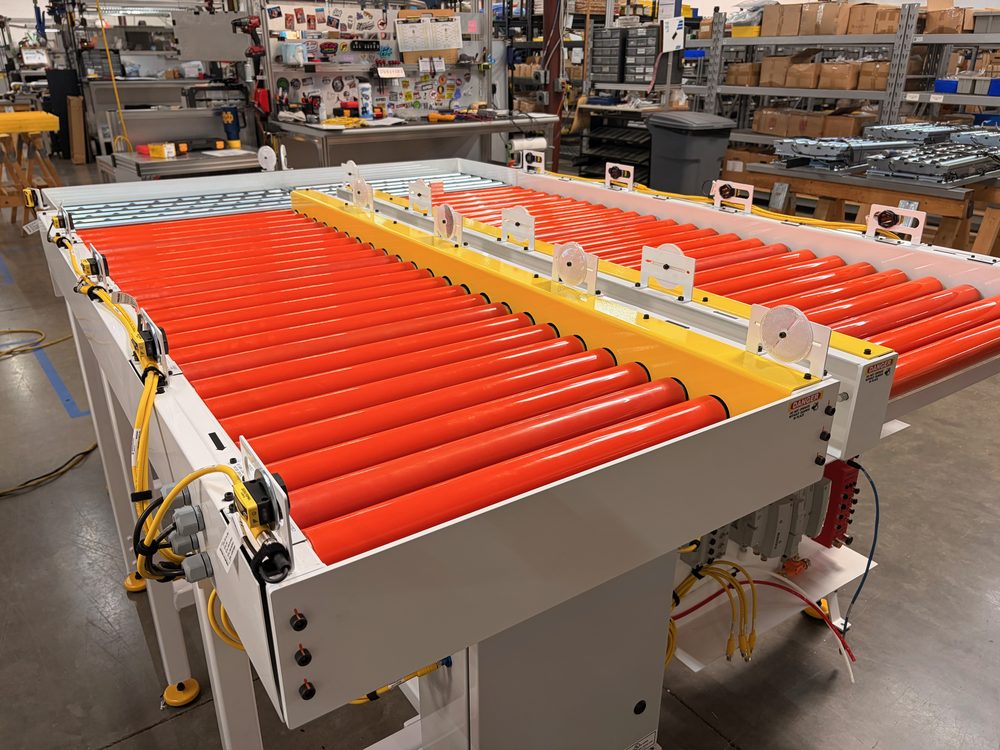
MDR is the most widely used powered roller conveyor in production and distribution today. Each conveyor is divided into independently controlled zones, each driven by a 24VDC motorized roller. When the zone ahead is occupied, the current zone holds. Products queue without touching each other. That’s zero pressure accumulation (ZPA), and it reduces product damage and handling errors on lines where accumulation is part of the process.
Direct Conveyors builds MDR systems in partnership with Rolmaster Conveyors, a manufacturer based in Cambridge, Ontario with over 75 years of production experience. Depending on the project scope, systems ship direct from Rolmaster or come through Direct Conveyors for additional fabrication and integration work before delivery.
Every MDR system is configured to the application. Drive type (O-ring or poly V belt), roller spec, sleeved rollers, zone sizing, and frame construction all get spec’d to the load, speed requirements, and line layout. Direct Conveyors helps determine the right configuration details for each project.
Chain driven live roller (CDLR) conveyors
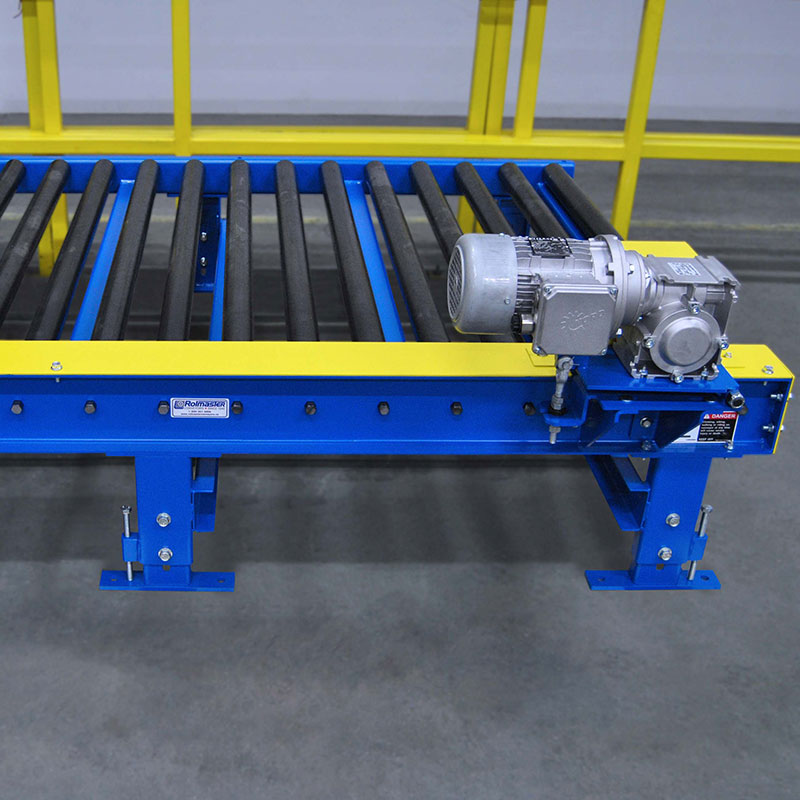
CDLR conveyors use a chain and sprocket drive to power the rollers directly. Every roller is positively driven by the chain. There’s no slip, no reliance on friction to transfer motion. That makes CDLR the right call for heavy loads, pallets, containers, and applications in dirty or oily environments where an MDR’s belt-driven zones wouldn’t hold up.
Common CDLR applications include pallet transport systems, end-of-line pallet handling, heavy bin and tote movement, and staging areas where a flat belt or MDR isn’t rated for the load. If the product is on a pallet or weighs more than a standard MDR zone is rated for, CDLR is typically the better fit.
Direct Conveyors builds CDLR systems with Rolmaster or builds to spec, with the same custom framing and integration capability that applies across the roller conveyor line.
Line shaft conveyors
Line shaft conveyors drive rollers through a rotating shaft and individual belt connections to each roller. They handle package accumulation and light sortation well, and they’re a cost-effective option where MDR zone control isn’t required but powered accumulation is. Line shaft is a mature technology that still fits specific applications in package handling and light distribution work.
Custom frame conveyor
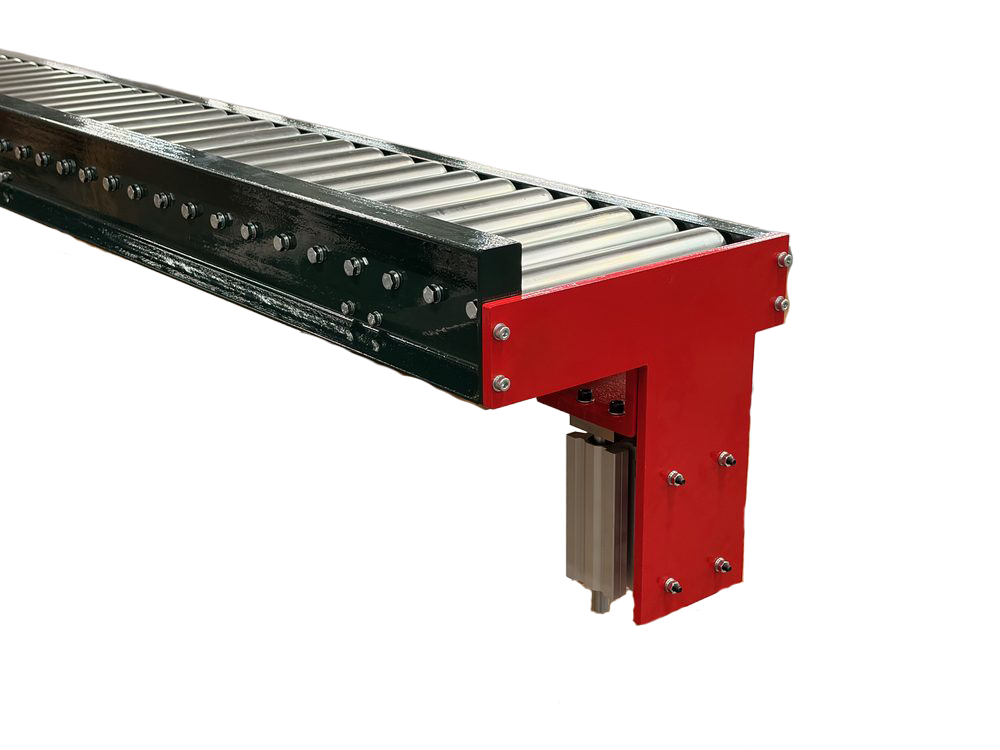
Across all roller conveyor types, the frame gets spec’d to the project. The standard starting point is 10-gauge steel side channel with an industrial enamel finish. From there, Direct Conveyors modifies frame dimensions, zone spacing, and configuration to fit the floor layout and load profile of the project.
For applications that require structural rigidity, Direct Conveyors builds in structural steel. Heavy loads, high-cycle environments, installations where frame flex would cause precision or safety problems. No give, no movement.
The frame is part of the custom scope alongside the drive selection and controls. If the standard fits, we use it. If the project needs something heavier or dimensionally specific, that’s what gets built.
Controls and integration
For powered systems, Direct Conveyors does not require any specific PLC brand, communication protocol, or control architecture. If you have an existing controls environment, we work within it. If you’re starting from scratch, we spec controls based on what the operation requires.
Integrators and plant engineers with an established controls standard don’t have to retool for the conveyor. Whether the application calls for 24V digital I/O, EtherNet/IP with an existing Allen-Bradley system, or something more involved, tell us what you have and we’ll spec the connection.
Ancillary equipment
Roller conveyor systems rarely run as a standalone line. Most applications involve some combination of merging, routing, sortation, or transfer requirements. Direct Conveyors sources, builds, and integrates the ancillary equipment the application calls for.
Common additions to a roller conveyor system:
- Mergers combine product flow from two or more input lanes into a single run.
- Diverts split product from a main line to one or more destination lanes.
- Sortation routes specific products to specific destinations based on logic or sensor input.
- Pushers move product laterally off the main conveyor run to an adjacent line or staging area.
- Lifts raise or lower product between conveyor runs at different elevations or to a workstation height.
- Transfers move product between lines that change direction or orientation.
- Turntables and ball transfer units handle directional changes where a fixed conveyor run isn’t practical.
Source depends on the application. Where Rolmaster carries the equipment, we use it. Where another supplier fits better, or where the application calls for something custom-built, we source or build accordingly.
Applications
On lines where product needs to accumulate or buffer without building contact pressure, MDR with ZPA handles it directly. Zones accumulate and release independently. Product ahead can sit while the zone behind stays loaded.
For heavier loads and pallets, CDLR is typically the better fit. Chain drive powers every roller positively. It handles the load capacities and environments that MDR wouldn’t: dirty floors, oily parts, heavy bins.
When the load is in a tote or bin and accumulation is part of the process, roller surface gives better product control than flat belt. MDR zone control keeps product from colliding during queuing.
When powered transport isn’t required, gravity roller is the answer. No motor, no controls, no zones to program. Workstations, receiving areas, and manual staging lines.
For robotic work cells and automotive tote handling, the Rolmaster M-Series is a modular gravity conveyor with adjustable incline and multi-tier configuration.
Direct Conveyors has built roller conveyor systems in automotive manufacturing and in the energy sector. Both involved real accumulation requirements, custom framing, and ancillary equipment integrated into the line.
If you’re working through which type of roller conveyor fits your application, tell us what you’re handling and we’ll tell you what we’d use.
Applications & Solutions
Applicable solutions from our portfolio: